Can the voters of a State take from the legislature the prerogative to draw lines of legislative districts and place it in the hands of an independent redistricting commission?

That is the issue squarely  before the United States Supreme Court in Arizona State Legislature v. Arizona Redistricting Commission, heard at oral argument on March 2.

The United States Constitution at Article 1 Section 4 seems to place the responsibility for setting the “Times., Places and Manner” of elections in the hands of the several legislatures, but the question is whether the electors of a State can modify that right by ballot initiative.

It’s a simple but important question.  The answer should be in hand no later than the end of May.

It is a Herculean accomplishment for an appellate attorney to have a case accepted at the United States Supreme Court.  After all, they take only about 75 cases per cycle out of more than 10,000 petitions requesting that they take a case.  That’s a 99.3% rejection rate.  Most attorneys go through their entire career never asking to have a case accepted at the Supreme Court.  A tiny fraction of those applying ever have one accepted.

Thus, lightening struck two times in the first year of the Finney Law Firm when the Supreme Court accepted and reversed two cases from the 6th Circuit Court of Appeals for our clients.

As we addressed here, this year the Finney Law Firm had another petition before the U.S. Supreme Court, a First Amendment case addressing yard sign regulation in the City of Garfield Heights, Ohio.  That case has virtually identical legal issues to another case before the Supreme Court, Reed v. Town of Gilbert that was heard on oral argument on January 12th of this year.  A decision in the Reed case is expected before the end of April.  Thus, we wrote in our certiorari petition to the Supreme Court that the Court should dispose of the Garfield Heights case in the same manner as the Reed case.

Friday, that petition was considered in conference by the US  Supreme Court.  And … all we can say with certainty is they did not deny the petition, as the Court does with 99% of the petitions before it.  Rather, it appears to us at present that they agree with our argument that the case mirrors the Reed case, and is holding our petition pending disposition of that case.

If so, it’s not quite like having another oral argument at the Supreme Court as we did just after Easter of last year, but it is still an utterly remarkable accomplishment.

Congratulations to attorney Curt Hartman and our Public Interest law team on this great achievement, three times in two years!

 

In yet another important First Amendment decision emanating from the case of Susan B. Anthony List v. Driehaus, the 6th Circuit Court of Appeals today upheld the decision of the trial court granting summary judgment to the Susan B. Anthony List on the defamation claim portion of the litigation.  That decision is here.

As background, the matter commenced with an administrative proceeding before the Ohio Elections Commission, where Congressional Candidate Steve Driehaus claimed that the Susan B. Anthony List made certain false statements in the 2010 Congressional election, namely that Driehaus supported legislation that included the spending of taxpayer monies for abortion.

The Susan B. Anthony List then proceeded into Federal Court, claiming that prosecution under Ohio’s “False Claims” statute violated its First and Fourteenth amendment rights.  That matter eventually ascended to the United States Supreme Court on standing grounds, wherein Plaintiffs prevailed 9-0 and the matter is now proceeding before the 6th Circuit on appeal on the substantive issues.

But Driehaus filed a counterclaim in the Federal action, claiming that the statements of the Susan B. Anthony List defamed him. District Court Judge Timothy Black initially sided with Driehaus in allowing the defamation claim to proceed to trial, but later reversed himself and dismissed the case on Summary Judgment initiated by Susan B. Anthony List.

That ruling on the Summary Judgment was on appeal before the 6th Circuit and is the subject of today’s opinion wherein the 6th Circuit sustained the ruling, but on alternate grounds.

It is an important First Amendment and defamation law pronouncement from the 6th Circuit.

As part of our commitment to “Make a Difference” for our community, Finney Law Firm has become a corporate sponsor of the Empower U adult education series.

Empower U has existed for six years, and puts out some of the very best information to citizens who want to be informed in their civic and personal affairs.  The classes are free to attendees.

Visit their web site and course offerings here.

In a decision that could have far-reaching implications against over-reach by state licensing Boards, today the United States Supreme Court ruled that under certain circumstances their actions could constitute violations of the Sherman Anti-Trust Act.

The issue in the case of North Carolina State Board of Dental Examiners v. Federal Trade Commission, No. 13-534, addressed the attempt by the Appellant to punish the provision of teeth whitening services by non-dentists.  

SCOTUS ruled that the facts that (i) the eight-member licensing board consisted of six dentists who were selected by the state’s licensed dentists and (ii) the panel operated largely outside of supervision by the State weighed in favor of denying the panel members the same immunity granted to the State under the Sherman Anti-Trust Act.

Given that licensing panels exist, at least in part, for the purpose of limiting competition in the provision of services offered by various professions, to the extent that they have the forgoing characteristic, both public and private Sherman Anti-Trust actions may lie.

Read about the decision here in the New York Times.

Read the decision here.

When the drafters of the Sarbanes Oxley Act made it a crime punishable for up to 20 years in prison to destroy “any record, document or tangible object” in order to obstruct an investigation, did they intend to address the throwing overboard of fish?  

That was the issue of sufficient importance to be decided today by the Supreme Court in Yates v. United States.

(The fish in question were evidence of a crime of catching a fish too short.)

In that action the Defendant/Appellant argued that the statutory prohibition is  “a documents offense” and that its reference to “tangible object[s]” means “computer hard drives, logbooks, [and] things of that nature,” not fish.

In other words, the question was whether the Court could apply a common sense interpretation of the statute rather than a broad dictionary definition of “tangible objects,” because fish certain are “tangible objects” by that term’s ordinary meaning.

In a 5-4 majority a common sense reading of the statute prevailed, and the criminal charges were thrown out.  Fish, it seems, are not “tangible objects.” 

Read the whole article here in the New York Times.

Read the decision here.

Thisx week, Christopher Finney will present “Reducing your property taxes” in two forums:

1) The consistently ground-breaking Empower-U lecture series will host Christopher Finney at Connections Christian Church, 7421 East Galbraith Road, on Tuesday, February 24, from 7 to 8:30 PM.  You can register and read about all of their course offerings for the Spring here.

2) Cincinnati Realtor Ellie Kowalchik and Summit Funding’s Aaron Denton team up for an informative evening on Thursday, February 26, from 6:30 to 8 PM at the Oasis Conference Center, Loveland, Ohio.  You may RSVP by emailing Ellie at [email protected] by February 18th.

All are invited to each of these courses.  We look forward to seeing you there!

We will write much more on this decision later, but today Finney Law Firm client prevailed 9-0 at the United States Supreme Court in a decision authored by Justice Clarence Thomas.

The full slip opinion is here.

Ten days ago experienced real estate attorney Rick Turner and his capable staff of Patti Gillespie and Evan Meredith joined our operations by launching Ivy Pointe Title, LLC, performing residential and commercial title and closing services.

Today, we are proud to announce their arrival with their new web site,  www.IvyPointeTitle.Com, and Facebook, Linkedin and Twitter accounts.

Further, we have implemented on-line ordering and will be serving our clients with a sophisticated client portal.  These are our first important commitments to evolving technology in the title industry.


Chris and Dusty 2
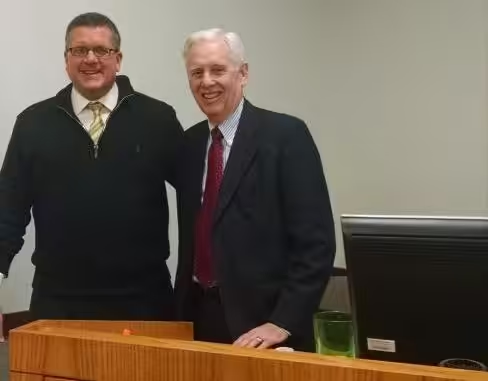
Chris Finney and County Auditor Dusty Rhodes

Each year for the past six years, we have been pleased to co-teach with County Auditor Dusty Rhodes a continuing education class to the Cincinnati Area Board of Realtors entitled “How to Reduce Your Property Taxes.”

The 3-hour class is designed to teach Realtors in detail how their Ohio tax bill is calculated and presented, and the process for challenging the Auditor’s valuation before Ohio’s 88 Boards of Revison.

This year the class, at the Board offices, was held on Wednesday, January 21.