

Some startup companies become successful businesses, but many more fail because they don’t take the steps necessary to put their companies on a workable basis or they take ill-advised actions that cost them dearly. 

Here are some common mistakes that you should avoid if you are starting up a new business: 

  • Failing to make a feasible business plan — If you don’t start out knowing what you hope to achieve and instituting a viable plan for how to achieve it, your business is likely to flounder quickly. In addition to serving as a roadmap to keep the business on track, a good business plan can help boost the confidence of your lenders and investors.
  • Misunderstanding your market — Startups are most successful when they fill a need not adequately served by current businesses. This doesn’t necessarily mean that you can’t offer a product or service to which your customer base doesn’t already have access, as long as it’s of sufficient quality to be competitive. You also need to price your product or service competitively and to encourage feedback from your customers for use in improving your business.
  • Having inadequate capital to succeed — It may take considerable time for your business to become profitable. Until then, you need to line up enough capital to keep it going. Shrewd budgeting can help keep unnecessary costs down, so that you can put your money where it will do the most good.
  • Inadequately protecting your personal assets — Startups are inherently risky, and you don’t want to lose your proverbial shirt because of business debts and possible lawsuits. You should make sure you have adequate insurance and consider organizing your company into a corporation or limited liability company that will protect your personal assets from current and future creditors if financial problems arise.
  • Failing to make suitable contracts — Depending on the type and size of your business, you will likely need to work on a regular basis with some independent contractors, such as suppliers, advertising or marketing firms. You can avoid unnecessary problems with them by making written contracts that are clear, enforceable and adequately protective of your interests, preferably with the assistance of an experienced business contracts attorney.

About Finney Law Firm, LLC

Founded in 2014, FLF has grown to 15 attorneys located in offices in Eastgate and downtown Cincinnati with five major practice areas: Corporate Law, Real Estate Law, Employment Law, Commercial Litigation and Public Interest and Constitutional Litigation.  FLF has the unique claim to three 9-0 victories at the United States Supreme Court for its public interest practice along with breakthrough class action work.

FLF also has an affiliated title insurance company, Ivy Pointe Title, LLC, that closes and insures nearly a thousand commercial and residential real estate transactions annually.

For more information about Finney Law Firm, visit finneylawfirm.com.

Media Contact: Mickey McClanahan; [email protected]; 513.797.2850.

 

Attorneys are only human and it is possible that your lawyer made a serious mistake or gave you poor advice that caused you to suffer a negative outcome in your case. If you are disappointed with the result of a matter you entrusted to an attorney, you may have a legal malpractice cause of action. An important question is how long you have to sue.

In Kentucky, the statute of limitations requires an injured party to sue within one year from the date of the occurrence of professional malpractice or from the date when the malpractice was discovered or reasonably should have been discovered. But this can be a difficult standard to apply, since legal errors are often not readily apparent to lay people.

Fortunately, a few Kentucky Supreme Court opinions have fleshed out the contours of this standard in a way that is intended to protect the rights of clients while avoiding unnecessary legal malpractice litigation.

First, the court has held that legal malpractice doesn’t occur until the lawyer’s negligence hurts the client in a way that is not speculative and can’t be reversed. Generally, this means that you can’t sue until you are out of normal remedies for correcting the error. For instance, in cases where the lawyer allegedly mishandled litigation, the court has said that the malpractice didn’t occur until the client’s right to appeal was exhausted.

Secondly, the court applies the “continuous representation” rule, which delays the start of the limitations period until after the relationship with the attorney ends. One rationale for this rule is that you can’t be expected to discover the legal malpractice as long as the attorney who committed malpractice is the one advising you. Often times, you are not in a position to know whether the attorney is doing a bad job or is merely faced with a bad case or an obstinate judge.

This rule also gives attorneys the opportunity to correct their mistakes. A legal malpractice lawsuit is a poor substitute for pursuing a still winnable case. This doesn’t mean you are required to stick with an attorney who you believe is not doing their job properly. You are entitled to seek better representation if you can. However, the rule is meant to give the client and the attorney the opportunity to solve the problem before the mistake becomes irreversible.

About Finney Law Firm, LLC

Founded in 2014, FLF has grown to 15 attorneys located in offices in Eastgate and downtown Cincinnati with five major practice areas: Corporate Law, Real Estate Law, Employment Law, Commercial Litigation and Public Interest and Constitutional Litigation.  FLF has the unique claim to three 9-0 victories at the United States Supreme Court for its public interest practice along with breakthrough class action work.

FLF also has an affiliated title insurance company, Ivy Pointe Title, LLC, that closes and insures nearly a thousand commercial and residential real estate transactions annually.

For more information about Finney Law Firm, visit finneylawfirm.com.

Media Contact: Mickey McClanahan; [email protected]; 513.797.2850.

 

Properly drafted written contracts are typically enforceable as against the parties thereto, with few exceptions – fraud being one of them. The manner in which written contracts are treated upon the allegation of fraud is highly dependent on the type of fraud alleged. In short, it is a question of whether the party claiming fraud alleges that they were defrauded as to the terms or nature of the contract or as to the facts and representations underlying the contract.

Void and Voidability

One of the most common scenarios in which this question arises is relative to settlement agreements and/or “releases,” where one party gives some consideration (e.g., money) in exchange for the settlement and release of actual or potential legal claims. The type of fraud being alleged determines whether the contract or agreement is automatically void (void ab initio) or merely voidable. “A release obtained by fraud in the factum is void ab initio, while a release obtained by fraud in the inducement is merely voidable upon proof of fraud.” Haller v. Borror Corp., 50 Ohio St. 3d 10, 13 (1990). “Whether a release was procured through fraud of either type is a question for the trier of fact [such as a jury]. Whether the fraud as alleged is in the factum or in the inducement is an issue of law for the court.” Id., at 14-15.

Fraud in the Factum

“A release is obtained by fraud in the factum where an intentional act or misrepresentation of one party precludes a meeting of the minds concerning the nature or character of the purported agreement.” Id. Imagine a grandchild telling her grandmother that she is signing a letter for school when it is really a change to her estate plan. “Where device, trick, or want of capacity produces ‘no knowledge on the part of the releasor of the nature of the instrument, or no intention on his part to sign a release or such a release as the one executed,’ there has been no meeting of the minds.” Id., quoting Picklesimer v. Baltimore & O. R. Co., 151 Ohio St. 1, 5 (1949).

Fraud in the Inducement

As the title would suggest, “[c]ases of fraud in the inducement. . . are those in which the plaintiff, while admitting that he released his claim for damages and received a consideration therefor, asserts that he was induced to do so by the defendant’s fraud or misrepresentation.” Haller, at 14. In Haller, the alleged fraud involved the financial solvency of a defendant company. In essence, a representative of the company allegedly represented to the plaintiffs that the company would soon be closed and, therefore, if Plaintiffs did not accept the offered settlement, they would likely receive nothing with respect to their claim(s). Id., at 11-12. The plaintiffs apparently later learned that this was not true. The Ohio Supreme Court found these allegations consistent with a claim of fraud in the inducement.

Practical Considerations

“A release of liability procured through fraud in the inducement is voidable only, and can be contested only after a return or tender of consideration.” Haller v. Borror Corp., 50 Ohio St. 3d 10, 14 (1990); see also Berry v. Javitch, Block & Rathbone, L.L.P., 127 Ohio St. 3d 480, 483 (2010) (“[A]n action for fraud in the inducement of a settlement of a tort claim is prohibited unless the plaintiff tenders back the consideration received and rescinds the release.”); Manhattan Life Ins. Co. v. Burke, 69 Ohio St. 294 (1903).

While it may seem obvious, one cannot seek to void a contract while retaining the consideration they received for the same. In Haller, the plaintiffs received $50,000 in exchange for a release of their prior claims. The Court, finding their allegations of fraud to be consistent with fraud in the inducement, held that the plaintiffs were required to tender back the $50,000 to the defendants before they could seek to void the settlement agreement and release. Because they had not done so, the release they signed remained valid and enforceable, and their claims (including those released under the settlement agreement and that of fraud in the inducement) were dismissed. This is consistent with the idea that one cannot “cherry-pick” which parts of a contract to enforce; they cannot denounce their obligations under a contract while retaining the benefits thereof.

When it comes to contract negotiations, these cases demonstrate how important it is to (a) start from a properly drafted contract, and (b) do your due diligence in order to mitigate the risk of later disputes and litigation. Our transactional team is uniquely positioned to help in these negotiations, having significant experience in contract drafting, negotiation, and disputes.

For assistance with contractual matters, contact Casey Jones (513.943.5673 )

Hamilton County Common Pleas Court Judge Wende Cross has certified two classes in White v. Cincinnati, litigation in which both the 1851 Center for Constitutional Law and Finney Law Firm represented payors of the illegal and unconstitutional Cincinnati tax on security alarm systems.  The two distinct classes certified are (a) residential and (b) non-residential payors of the Cincinnati alarms tax.

The City charged residential alarm-system-owners $50 per year to register their systems and commercial owners $100 to register their systems.  Last fall, the 1st District Court of Appeals unanimously ruled the tax illegal under Ohio law and unconstitutional, overruling a trial Court ruling on the same subject.  In March of this year, the Ohio Supreme Court preserved that victory for Cincinnati property owners when it refused to accept discretionary review of the case.

We now proceed to an an Order that will establish the amount and procedures for the restitution of the illegally-collected sums, a fairness hearing, and then distribution of the refunds to payors.  We aim for the conclusion of those steps this calendar year.  The amount of restitution is expected to be more than $3.6 million.

For questions, contact Chris Finney at 513.943.6655.

You may read the order issued April 22 here.


Until now, School Districts in Ohio were fully empowered to participate in legal proceedings to oppose the lowering of Auditor’s property tax valuations and to seek increases in property tax valuations.  No more.

As we explain here, the Ohio House and Senate in the past few weeks passed legislation that upends the current equilibrium among County Auditors, property owners and school boards, to tilt matters decidedly in favor of property owners. (In fairness, Ohio had granted school boards a far greater role in the process than most other states.)

Today, Governor DeWine signed that bill, Am. Sub. H.B. 126, into law.  Read the summary of the legislation here.  The Cleveland Plain Dealer covers today’s events here.

For assistance with property tax valuation matters, please contact Chris Finney (513.943.6655) or Casey Jones (513.943.5673).

As we previously wrote about, here, Finney Law Firm was honored to serve as co-counsel to Tea Party groups throughout the nation in what we believe was the only certified class action ever against the Internal Revenue Service for its targeted discrimination against the plaintiffs resulting in protracted delays in processing and granting tax exemption status due to their political viewpoints. The targeting was led by Obama administration IRS official Lois Lerner and her chief deputy at the IRS, Holly Paz.

After years of pitched legal battles, that litigation ended with a dramatic settlement in which the IRS paid damages to Tea Party groups, the IRS paid the Tea Parties’ attorneys fees, and then-US Attorney General Jeff Sessions issued a personal apology on behalf of the United States of America that included this unequivocal statement about the IRS intentional wrongdoing: “this abuse of power will not be tolerated.”

In that litigation, plaintiffs succeeded in obtaining the depositions of Lerner and Paz, but the transcripts of the depositions — finally revealing their own testimony about the origins and implementation of the outrageous policies and practices — have remain sealed under a temporary emergency Order by Judge Michael Barrett. (Even US House and Senate Committees investigating the wrongdoing were stymied in getting that testimony when Lerner and Paz each invoked their 5th Amendment right against self-incrimination.)  That Order bottling up the deposition transcripts was never made final, and thus it could not be appealed.  Thus, to this day — more than three years later — the deposition transcripts remain hidden from public scrutiny.

As a result, this week, Plaintiff’s counsel filed a Motion for Writ of Mandamus before the 6th Circuit Court of Appeals seeking to have the depositions unsealed.  You may read the Motion here.

If you own a business or engage in any other profession in Kentucky, you depend on your reputation to draw the customers or clients you need. Even in your private life, you want to maintain a good name. But all that can be undermined if someone makes false statements about you. Kentucky and other states recognize that such statements, known as defamation, may entitle you or your business to recover money damages for the resulting loss of reputation. Usually, you need to prove actual injury but in some cases — those involving defamation per se — the injury might be presumed.

Defamation per se is defined as spoken or written language that exposes the plaintiff to public hatred, ridicule, contempt or disgrace. It can also be a statement that causes people to have such a negative opinion of the plaintiff that they refuse to associate with him or her. Examples are statements that accuses a person of incest or adultery or unfairly prejudices the public against the person in their business or profession.

However, a federal court case applying the Kentucky law of defamation per se in a commercial context declared that it is not enough to say that a business’ product is bad. To be defamation per se, a statement must suggest that the business engaged in fraud, deceit, or dishonest or other reprehensible conduct.

There is also a distinction between what counts as libel per se or as slander per se. In a case of libel, which means defamation in writing, the court looks at the ordinary, natural meaning of the express language itself to determine whether it’s defamatory per se. For slander, which means spoken defamation, it is sufficient that the language used merely implies fraud, dishonesty, a crime or other illegal or unethical conduct.

In defamation cases, the damages that a jury may award to individuals or corporations include:

  • Damage to the plaintiff’s reputation
  • Specific economic damages, such as loss of employment or profits
  • Punitive damages, if the defendant’s conduct was oppressive, malicious or fraudulent

The significance of a finding of defamation per se is that it automatically establishes the plaintiff’s entitlement to damages without having to show an exact dollar amount of harm suffered. However, it is still important for plaintiffs to quantify their damages in order to maximize recovery. Otherwise, the jury is left to its own subjective determination of damages, which may be far lower than deserved.

About Finney Law Firm, LLC

Founded in 2014, FLF has grown to 15 attorneys located in offices in Eastgate and downtown Cincinnati with five major practice areas: Corporate Law, Real Estate Law, Employment Law, Commercial Litigation and Public Interest and Constitutional Litigation.  FLF has the unique claim to three 9-0 victories at the United States Supreme Court for its public interest practice along with breakthrough class action work.

FLF also has an affiliated title insurance company, Ivy Pointe Title, LLC, that closes and insures nearly a thousand commercial and residential real estate transactions annually.

For more information about Finney Law Firm, visit finneylawfirm.com.

Media Contact: Mickey McClanahan; [email protected]; 513.797.2850.
 

A bill passed this week by the Ohio legislature could make major changes in the current process for Ohio tax valuation challenges before Ohio Boards of Revision as it relates to participation by Boards of Education if Governor DeWine signs it into law.

Unlike the procedures in many other states, in Ohio, Boards of Education (the major recipients of property tax monies) may both initiate complaints to increase the valuation of real property (and thus increase property taxes owed) and may oppose a property owner’s legal attempts to secure a reduction in tax values as well.

Some major features of the legislation, Am. Sub. H.B. 126, follow:

  1. School districts may not initiate a complaint to increase valuation unless the challenge meets all of three requirements (a) the challenge is based upon an actual arm’s length sale of the subject property before the tax lien date in question (this would then, it seems, also rule out challenges at all of “entity transfer” sales and sales after the tax lien date in question), (b) the sale is at least 10% above the then-established Auditor’s valuation and (c) such sale price exceeds the Auditor’s valuation by at least $500,000 (that amount is then annually subject to a CPI adjustment).
  2. Boards of Education would have to carefully undertake extensive and detailed procedures to specifically authorize by resolution such challenges, on a property-by-property basis, with at least seven days’ advance certified mail notice to each affected property owner.  The level of detail of these procedures appears to be nothing more than a series of procedural traps for Boards of Education to discourage their involvement in the tax valuation process.
  3. The involvement of Boards of Education stop at the Board of Revision.  While property owners or the Auditor may pursue an appeal of a Board of Revision decision, Boards of Education will have no authority to appeal (or participate in a property owner appeal) of a Board of Revision decision.
  4. Presently, property owners may enter into private settlements with school districts to avoid or end their opposition to a valuation reduction or its attempts to seek valuation increases. H.B. 126 will outlaw the practice of entering into these “side deals.”

More minor changes include:

  1. Boards of Education may file counterclaims to property owner complaints to reduce valuations only if the initial Complaint seeks a reduction of at least $17,500 (Boards of Education rarely if ever file counterclaims below this level at present).
  2. Boards of Revision lose jurisdiction to increase valuations of claims by Boards of Education are not acted upon within one year of the date of the filing of the Complaint (in our experience, this delay only happens in a few large urban counties in the year following a triennial revaluation, so this type of prolonged delay is quite uncommon).

There is no language in the bill about its effective date, upon our initial review, and thus it would seem its effective date would be 91 days after it becomes law (under the Ohio Constitution).  Thus, some of these provisions (pursuit of appeals, for example) could have an impact on valuation complaints and school board counterclaims filed in calendar year 2022.

We will promptly update this blog when Governor DeWine either vetoes or signs the legislation into law. He has 10 days to act, or the bill automatically becomes law.

Read more about the legislation here:

Read the actual legislation here. Contact Chris Finney (513.943.6655) if you have questions about the legislation or desire to pursue or defend against an Ohio or Kentucky property tax valuation challenge.


Listen in as Chris Finney discusses his 8-0 unanimous victory against the Ohio Civil Rights Commission as they attempted to extract money for a tenant in an entirely frivolous case.  The conduct of the Ohio Attorney General’s office and the Ohio Civil Rights Commission was shameful and outrageous in this case.


Truth can be stranger than fiction.  And the last few weeks at the Finney Law Firm that has been the case.

Yesterday, Chris Finney, Jessica Gibson and Julie Gugino racked up a unanimous jury verdict (8-0) to defeat a case of claimed retaliation in response to a tenant’s claimed request for a disability accommodation that was met with a non-renewal of a residential lease.  The case was styled Ohio Civil Rights Commission v. Abundant Life Faith Fellowship in front of Judge Christian Jenkins in Hamilton County Common Pleas Court.  The Civil Rights Commission was also suing the Church’s pastor who had served for 41 years.  In candor, the Civil Rights Commission did a terrible job of vetting its own case with a terrible, dishonest plaintiff and a very sympathetic defendant.  Its attorneys at trial also were not exactly prepared or stellar.

The Civil Rights Commission case was full of demonstrable untruths about a kind-hearted 74-year-old African American minister who had suffered two strokes.  By the testimony of two of her fellow tenants in the building, the complaining tenant had plotted starting fewer than two weeks into her tenancy to drum up a fictitious lawsuit against the landlord as a way to extract money from him — she told this to her fellow tenants.  And for a year, she made his life a living hell, with incessant complaints about inadequate heat and fabrication about needing more light for a vision disability (in fact, her complaints about lighting had been adequately addressed early in her tenancy).  Dozens of complaints were addressed by visits by with servicemen, engineers, and repairmen to cater to her many whims and incessant gripes.  The Cincinnati Health Department came out and confirmed the unit in every room was heated to a comfortable 72°F to 73°F (the tenant lied to the jury — never a good idea — and said the readings were 62°F, 64°F and 66°F).

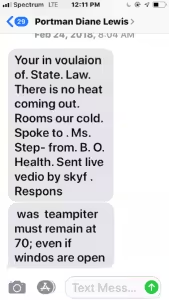
In the funniest part of the trial, the tenant at first denied and then admitted sending a bizarre text message to the landlord in the depth of winter, after he noticed that the windows of every unit in the building were open, including those of the tenant who constantly complained it was too cold!  Here is the text message, grammatical errors and misspellings included:

Yes, her crazy assertion to the landlord was that he must maintain the heat in the unit at 70°F even if the windows of the unit are left open!

Of course Pastor Brown and the Church had to fund the 4-year defense of the Civil Rights Administrative Complaint and the lawsuit, which he did with aplomb, but at great expense.  For the benefit of all landlords subject to outrageous prosecutions from obstinate public agencies, he saw this case through to its appropriate and proper end.  He refused to be bullied by the Ohio Civil Rights Commission, the office of the Ohio Attorney General and Housing Opportunities Made Equal (H.O.M.E.) (which manufactured evidence and knowingly lied to the Civil Rights Commissions in “building their case”).

For more information or to avoid being bullied by these same agencies: (a) DO NOT TALK TO THEM in an investigation EVER and (b) contact Jessica Gibson  (513.943.5677) for assistance with your case.