Finney Law Firm represents Mark Miller in two lawsuits against Cincinnati City Councilmembers Dennard, Landsman, Seelbach, Sittenfeld, and Young. The first involving violations of Ohio’s Open Meetings Act; the second involving violations of Ohio’s Public Records Act. Read about recent filings in the Open Meetings Act case here.

In the Public Records Act case – before the Hamilton County Court of Appeal – the Councilmembers filed a motion for in camera review and for a protective order to prevent dissemination of the Councilmembers’ text messages and emails

They Councilmembers admit that there are additional emails and text messages that should have been provided in response to our public records request but contend that they somehow are not “public records” as that term is defined in Ohio law.

We find the Councilmember’s motion disingenuous, particularly in light of their own recent leaking of some text messages to a friendly attorney who then filed a motion to intervene in the Open Meetings suit on behalf of their political ally, Derek Bauman.

The Councilmembers’ motion can be read here.

Our memorandum in opposition can be read here and below.

[scribd id=383740777 key=key-dtiBHqAv2KOmi5vluPzF mode=scroll]

Finney Law Firm represents Mark Miller in two lawsuits against Cincinnati City Councilmembers Dennard, Landsman, Seelbach, Sittenfeld, and Young. The first involving violations of Ohio’s Open Meetings Act; the second involving violations of Ohio’s Public Records Act. Read about recent filings in the Public Records Act case here.

In the Open Meetings case – before Judge Ruehlman of the Hamilton County Court of Common Pleas – the Councilmembers recently filed a motion to limit and prevent discovery and publication of any documents produced in discovery. Today we filed our memorandum in opposition to that motion.

The Councilmembers ask the Court to prevent discovery because they claim some of the emails and text messages may contain information embarrassing to themselves or third parties. We point out to the Court that those third parties can easily be invited to state for themselves whether they want the materials released to the public; and that the law requires more than simply reciting the words “risk of embarrassment” before the Court can limit discovery.

Ohio’s Courts, like every other public body, are to be open to the public. By attempting to prevent public access to information produced in discovery, the Councilmembers ask the Court to facilitate their violations of the Open Meetings Act.

The Court has scheduled oral argument for this motion on August 16 at 11 a.m. in Room 300 of the Hamilton County Courthouse.

The Councilmember’s motion can be read here.

Our memorandum in opposition can be read here and below.

[scribd id=383738790 key=key-1gnTG4Ik6Opw29XE8e3I mode=scroll]


The Kentucky Workers’ Compensation Act (WCA) lists the requirements for employers related to workers’ compensation. The benefits themselves are administered by the Kentucky Department of Workers’ Claims (DWC), which also enforces each employer’s compliance with the WCA.

The vast majority of employers in Kentucky must comply with the WCA. Employers are subject to the legislation if:

  • They employ at least one person
  • They are not solely focused on agricultural work

Even if an employer is exempt from the rules of the WCA, it can still elect to become subject to WCA rules by complying with coverage requirements.

WCA coverage requirements

The WCA requires all nonexempt employers to maintain workers’ compensation coverage for employees. This can be done in one of two ways:

  • Purchasing a workers’ compensation insurance policy from an entity that has been authorized to provide such policies in the state of Kentucky
  • Obtaining approval from the DWC to self-insure as part of a group or as an individual employer

Employers must pay the full cost of workers’ compensation coverage and cannot deduct portions of that cost from the salaries or wages of their employees.

The DWC ensures all workers’ compensation policies that employers provide meet the minimum standards of the WCA. The agency maintains compliance by requiring insurance companies to submit all policies for approval before they are issued. Then, in accordance with the WCA, the insurance companies take the role of paying workers’ compensation benefits, a role that would otherwise be left to the employer.

Workers’ compensation policies must cover the employer’s full benefits liability for each employee. Employers may also cover their liability with two different policies, so long as they have obtained a DWC-approved 24-hour health insurance policy. This policy provides integrated workers’ compensation coverage for group health benefits in addition to the medical part of workers’ compensation benefits.

About Finney Law Firm, LLC

Founded in 2014, FLF has grown to 15 attorneys located in offices in Eastgate and downtown Cincinnati with five major practice areas: Corporate Law, Real Estate Law, Employment Law, Commercial Litigation and Public Interest and Constitutional Litigation.  FLF has the unique claim to three 9-0 victories at the United States Supreme Court for its public interest practice along with breakthrough class action work.

FLF also has an affiliated title insurance company, Ivy Pointe Title, LLC, that closes and insures nearly a thousand commercial and residential real estate transactions annually.

For more information about Finney Law Firm, visit finneylawfirm.com.

Media Contact: Mickey McClanahan; [email protected]; 513.797.2850.

 

This morning the Ohio Supreme Court accepted our appeal from a Cuyahoga County Court of Appeals case questioning whether Ohio’s Open Meetings Act permits public bodies to vote by secret ballot.

A 2011 Ohio Attorney General’s Opinion Letter says no, as does a 2011 Hamilton County Common Pleas Court decision. But to date, the Ohio Supreme Court has not addressed this question. But the Cuyahoga County Courts disagreed.

This is an important case, meriting an amicus brief in support of jurisdiction from the Ohio Coalition for Open Government. Learn more about OCOG here.

The Ohio Supreme Court now has an opportunity to declare once and for all that secret ballot voting is not consistent with the demands of open government.

Case documents in State of Ohio ex rel. More Bratenahl et al. v. Village of Bratenahl et al.  are available on the Ohio Supreme Court’s website, here.

We will post updates as briefing is completed. Read more about this case here.

Today, attorneys for the City of Cincinnati filed the self-proclaimed “Gang of Five’s” answer to the April 9, 2018 Open Meetings Complaint (read the complaint here, read additional blog posts about the case here and here).

Surprisingly, the Gang of Five deny that they conducted meetings via telephone, email, and text message.  We say surprisingly, because the emails and text messages attached to the complaint make clear that the Gang of Five did conduct such meetings.

The councilmembers’  responses to interrogatories and requests for documents are due later this month, and depositions are set to begin shortly.

[scribd id=380988345 key=key-xzHGFm3H8LOpoQ42PC7i mode=slideshow]

As has been discussed in numerous posts on our firm’s blog, see here, here, and here, the changes to Ohio’s property valuation law enacted in 2012 are slowly coming into effect as the Ohio Supreme Court has been consistently ruling that the changes made by the legislator mean exactly what they say.

Notably, R.C. 5713.03 was amended specifically to require that real property be valued for taxation purposes, “as if unencumbered.” But auditors and school boards have resisted calls to apply the plain meaning of “as if unencumbered” to include leases, arguing that “as if unencumbered” refers only to liens or easements.

Yesterday (May 22, 2018) the Ohio Supreme Court weighed in again on the question in Lowe’s Home Centers, Inc. et al. v. Washington County Board of Revision, et al., Slip Opinion No. 2018-Ohio-1974, that “it is plain that a lease is an encumbrance and that R.C. 5713.03’s directive to value the realty ‘as if unencumbered’ means to value the realty as if it were free of encumbrances such as leases.” Id. at ¶19.

In Lowe’s, the County’s appraiser compared leased fee properties to the subject property to ascertain the value, and made adjustments to account for the leases. The Board of Tax Appeals adopted the value proposed by the County’s appraiser, but appeared to rely on a case decided prior to the amendments to R.C. 5713.03, thus leaving some question whether the Board of Tax Appeals analyzed the lease adjustments.

Unquestionably, the changes, aimed mostly at commercial property valuation, bring with them new challenges for Ohio’s auditors and school boards (the major recipient of property tax dollars). And there are certain to be calls for new amendments to undo some or all of the recent changes.

The deadline for filing Board of Revision Challenges has passed for this year. To learn about the Board of Revision process in preparation for next year, watch Chris Finney’s presentation here. Contact us here if you have questions about your commercial property valuation.

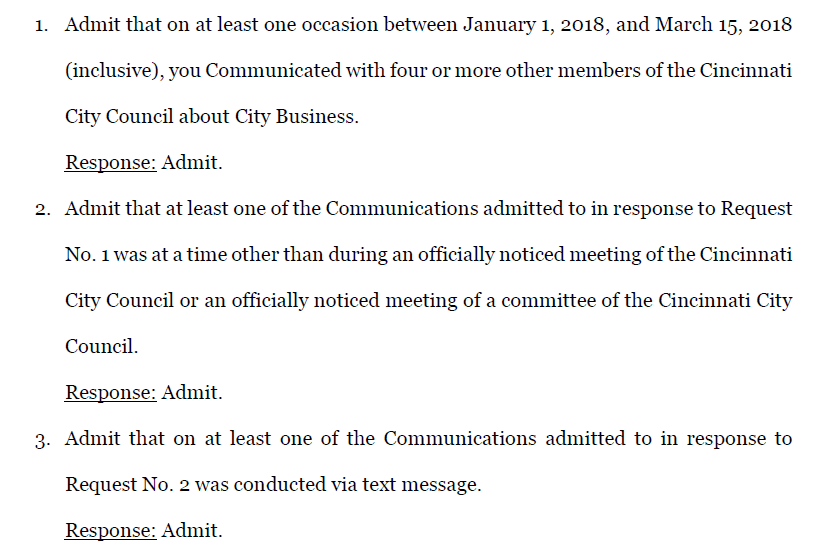
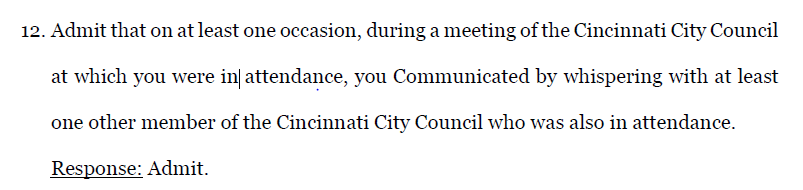
As part of their responses to the first round of discovery in our Open Meetings lawsuit, Cincinnati City Council Members PG Sittenfeld, Chris Seelbach, Wendell Young, Tamaya Dennard, and Greg Landsman – the Self-Proclaimed “Gang of Five” – have now admitted to additional Sunshine Law violations: other meetings conducted via text message, and whispering and texting to each other during City Council meetings.

Thus far, the Gang of five have only responded to our requests for admission, still outstanding are responses to our interrogatories and requests for documents. The City asked for, and we granted, an extension of time to respond to the interrogatories and document requests. Those responses will shed even more light on the topics of discussion during the illegal meetings and result in the production of additional text message correspondence between the Gang of Five.

What is unquestionable now is that the question of firing the City Manager was not the first time the Gang of Five discussed public business outside the public eye, in clear violation of Ohio’s Sunshine Laws and the Cincinnati City Charter.

Next steps are to obtain the additional written discovery responses and then depose the Gang of Five under oath.

How much liability, if any, do general contractors have for faulty construction when subcontractors are also involved in a project? The answer to this question depends not just on the circumstances of the case but also on the state where the project is taking place.

In recent years, Kentucky law has been tougher on general contractors in these cases than other states, which has led some construction law observers to argue the state’s Supreme Court should consider revisiting the issue.

When a general contractor hires a subcontractor, there is always an expectation that the subcontractor will perform its work in a high-quality manner. Shoddy work performed in a negligent way not only creates a higher likelihood of property damage and construction defects, but could also cause significant harm to the general contractor’s reputation.

General contractors often left on the hook

Unfortunately, Kentucky law is unfavorable to policyholders in some types of construction cases.

In 2010, for example, the Kentucky Supreme Court ruled the faulty workmanship of a subcontractor on a construction project cannot be accidental. This was in the case of Cincinnati Ins. Co v. Motorists Mut. Ins. Co., which set the unusual precedent that in cases involving shoddy construction, general contractors essentially hire a subcontractor with the expectation that the work performed will be subpar.

Other states have repeatedly gotten this issue right over the years, which means it may be time for the Kentucky Supreme Court to take another look at the decision and overturn its ruling. The vast majority of state supreme courts have ruled that faulty workmanship can be (and typically is) accidental, which means it’s considered a covered “occurrence.”

When the Kentucky Supreme Court issued its Cincinnati ruling, it pointed to several other states that applied similar rules. Five of those states — Arkansas, Colorado, North Dakota, South Carolina and West Virginia — now apply the opposite rule in these cases.

About Finney Law Firm, LLC

Founded in 2014, FLF has grown to 15 attorneys located in offices in Eastgate and downtown Cincinnati with five major practice areas: Corporate Law, Real Estate Law, Employment Law, Commercial Litigation and Public Interest and Constitutional Litigation.  FLF has the unique claim to three 9-0 victories at the United States Supreme Court for its public interest practice along with breakthrough class action work.

FLF also has an affiliated title insurance company, Ivy Pointe Title, LLC, that closes and insures nearly a thousand commercial and residential real estate transactions annually.

For more information about Finney Law Firm, visit finneylawfirm.com.

Media Contact: Mickey McClanahan; [email protected]; 513.797.2850.

 

As part of his political “house cleaning” when he first took office, Aftab Pureval paid severance packages to outgoing employees and required that they sign non-disclosure agreements. Local government watchdog Mark Miller asked for copies of these records, only to be ignored by Aftab Pureval.

Now, six weeks after Pureval received the request, and with no response whatsoever from Pureval, Finney Law Firm filed suit to force the release of the requested records.

It is expected that the records will show that Pureval used attorneys other than his official statutory counsel in drafting these agreements, and that the agreements are legally unenforceable; that they were simply a means of coercing former employees into silence as he prepared his run for higher office.

Read the complaint below or click here to view it on Scribd.

[scribd id=377796673 key=key-tff3AszQ6iZyPzYNIFo4 mode=scroll]

The term “deceptive trade practices” encompasses any type of advertising or labeling intended to somehow mislead or deceive consumers. Kentucky has extensive consumer protection laws — in addition to federal laws — to protect consumers from suspicious or disingenuous advertising and sales tactics. There are also mechanisms to punish companies that engage in these practices.

While Kentucky is not one of the states that has adopted the Uniform Deceptive Trade Practices Act, it still has plenty of statutes in the Consumer Protection and Criminal sections of its revised statutes. These laws prohibit companies from intentionally misleading consumers.

Businesses that violate these regulations could be forced to pay remedies, such as reasonable attorney’s fees, fines worth hundreds of dollars and, in severe cases, imprisonment for the owners.

Additional consumer protections

Beyond the laws that Kentucky and the federal government have established to prevent businesses from purposefully deceiving customers, there are plenty of other means for consumers to protect themselves and exercise their rights. This is important, as state laws are limited in terms of the remedies they can provide after a scam has already occurred.

Consumer protection offices are scattered throughout the state and provide Kentuckians with up-to-date information on scams in those specific areas. Local residents can report individuals or businesses in their area who engage in misleading business practices by filling out paperwork and submitting it to one of these offices.

Additional resources include www.consumeraction.gov, a federal website developed with the intent of providing consumers with another outlet to report wrongdoing. The Better Business Bureau also keeps an eye on misleading practices.

About Finney Law Firm, LLC

Founded in 2014, FLF has grown to 15 attorneys located in offices in Eastgate and downtown Cincinnati with five major practice areas: Corporate Law, Real Estate Law, Employment Law, Commercial Litigation and Public Interest and Constitutional Litigation.  FLF has the unique claim to three 9-0 victories at the United States Supreme Court for its public interest practice along with breakthrough class action work.

FLF also has an affiliated title insurance company, Ivy Pointe Title, LLC, that closes and insures nearly a thousand commercial and residential real estate transactions annually.

For more information about Finney Law Firm, visit finneylawfirm.com.

Media Contact: Mickey McClanahan; [email protected]; 513.797.2850.