Contractors, laborers, and materialmen tend to run into issues receiving payment for their work on certain projects. A terrific way for contractors, laborers, and materialmen to guard against not getting paid is to attach a Mechanic’s Lien to the property on which the contractors, laborers, and materialmen performed their work. From an extremely general point of view, to perfect a Mechanic’s Lien, contractors, laborers, and materialmen must file an “Affidavit for Mechanic’s Lien,” with the recorder’s office in the county where the property is located.

It is key to remember that there are time limits that must be adhered to on the front end and back end of filing an Affidavit for Mechanic’s Lien.

The Front End

When it comes to the front end, the time limit will vary based on the type of project.

If the Mechanic’s Lien is associated with a residential property, like a family home or condominium, then a contractor, laborer, or materialman claiming a Mechanic’s Lien has sixty (60) days from the date that the last labor was performed, or material was provided by the contractor, laborer, or materialman.[1]

If a Mechanic’s Lien is associated with oil or gas wells or facilities, then a contractor, laborer, or materialman claiming a Mechanic’s Lien has one hundred and twenty (120) days from the date that the last labor was performed, or material was provided by the contractor, laborer, or materialman.[2]

For all other Mechanic’s Liens, a contractor, laborer, or materialman claiming a Mechanic’s Lien has one seventy-five (75) days from the date that the last labor was performed, or material was provided by the contractor, laborer, or materialman.[3]

The Back End

ORC Section 1311.13 deals with attachment of liens, continuance, and priority. ORC Section 1311.13(C) states that Mechanic’s Liens, under sections 1311.01 to 1311.24, continue for six years after the Affidavit for Mechanic’s Lien is filed with the county recorder, as required by ORC Section 1311. If a cause of action based on a Mechanic’s Lien is brought within the six years, then the Mechanic’s Lien will continue “in force until final adjudication thereof.”

If a cause of action based on a Mechanic’s Lien is not brought within the six-year period, then the rights associated with the Mechanic’s Lien are extinguished.[4] Thus, there is a six-year statute of limitations to bring a cause of action based on a Mechanic’s Lien.[5] Furthermore, “the statutory scheme for the filing and enforcement of [M]echanic’s [L]iens does not provide for the tolling or expansion of designated statutory time limits.”[6]

If you have a Mechanic’s Lien and need to act, please feel free to reach out to the Finney Law Firm, before it is too late!

_____________________

[1] ORC Ann. 1311.06(B)(1).

[2] ORC Ann. 1311.06(B)(2).

[3] ORC Ann. 1311.06(B)(2).

[4] Banner Constr. Co. v. Koester, 2000 Ohio App. LEXIS 1313, *1.

[5] Id.

[6] Id.

Today, President Joseph Biden announced immediate and significant changes to the Paycheck Protection program, as follows:

  1. Priority period for businesses with fewer than 20 employees for two weeks starting this Wednesday, February 24th.
  2. Different loan (grant) calculation for sole proprietors and a set-aside of $1 billion for businesses in low- and moderate income areas.
  3. Made eligible those with non-fraud felony convictions.
  4. Made eligible business owners with student loan defaults.
  5. Made eligible all lawful U.S. residents with visas or Green Cards.

Forbes magazine has more details on these breaking developments here.

Defamation is a common law tort that can be directed at a person, business, a business owner or employees of a company. The defamatory statement can be written (libel) or spoken (slander). In order to be considered defamation, it must be a false statement of fact, not an opinion, about the business entity or one of its officers or employees. The statement has to be made publicly, as in a newspaper or on the internet, or be spoken to a third party.

The business that has been defamed must prove that it has suffered actual damages — such as lost revenue, diminished ability to hire new employees or decreased business volume — as a result of the false statement.

An investigation to determine the potential impact of a defamatory statement may be necessary. It would include determining the print and online circulation of a newspaper that published the defamatory statement. For a defamatory statement on the internet, a diligent investigator might examine the web traffic for the website that published the statement in question. That examination can count how many “views” were made of the statement and the number “clicks” on the piece containing the statement, thereby showing to what extent the defamatory statement may have spread. If the statement was made on Facebook, Twitter or other social media, the poster’s number of followers is also an indicator of the statement’s reach.

If the defamatory statement was first spoken, the third parties who heard the statement should be located and identified. If the statement was repeated, or otherwise memorialized, the letters, emails, tweets or other communications containing the statement should be tracked down.

Certainly, one of the key components of any business is its reputation in its industry or, for a small business, its community. Once the defamatory nature of the statement is confirmed, the business law attorney representing the company can issue a cease-and-desist letter to the person or entity that made the statement. The attorney can also demand that the person or entity that made the statement issue a retraction. A properly worded retraction might go a long way towards restoring the good reputation of the damaged business and stemming any losses the business is incurring because of the defamatory statement.

About Finney Law Firm, LLC

Founded in 2014, FLF has grown to 15 attorneys located in offices in Eastgate and downtown Cincinnati with five major practice areas: Corporate Law, Real Estate Law, Employment Law, Commercial Litigation and Public Interest and Constitutional Litigation.  FLF has the unique claim to three 9-0 victories at the United States Supreme Court for its public interest practice along with breakthrough class action work.

FLF also has an affiliated title insurance company, Ivy Pointe Title, LLC, that closes and insures nearly a thousand commercial and residential real estate transactions annually.

For more information about Finney Law Firm, visit finneylawfirm.com.

Media Contact: Mickey McClanahan; [email protected]; 513.797.2850.

 

Correct service of process is a basic and vital part of initiating a lawsuit. In American jurisprudence, courts need to know that defendants have received actual notice of the existence of lawsuits filed against them. Service of process on a foreign person or entity can be complicated but must be completed properly or the plaintiff risks having the suit dismissed.

The United States is a signatory to the Hague Convention on the Service Abroad of Judicial and Extrajudicial Documents. The purpose of the Hague Convention is to formalize serving lawsuit papers and other documents in a timely and simple manner to ensure that foreign persons or entities sued in another country receive actual notice of legal actions against them.

Under the Hague Convention, signatories designate a “central authority” to accept documents to be served on persons or entities in that country who are named as defendants. The central authority then effects service on those parties according to local law and provides proof of service to the plaintiffs.

It is important for plaintiffs and their business lawyers who are suing foreign persons or entities in the United States to be aware of the service-of-process laws in the country where the named defendants are situated. Under Alternative A of the Hague Convention, parties may directly serve documents by mail on other parties to the suit if permitted by the country where the defendant lives. If a country does not permit direct service by mail, the serving party must serve legal documents through the central authority. In some countries, the central authority requires that the legal documents to be served are in that country’s official language.

If the country in which a defendant resides is not party to the Hague Convention, Kentucky law permits service of process through registered mail.

Another way to effect service of process on a foreign entity is to serve that entity’s registered agent in the United States. If there is no registered agent, the foreign entity’s subsidiary may be served if it is an actual or apparent agent of the corporate parent and the corporate parent exercises dominion or control over the subsidiary.

About Finney Law Firm, LLC

Founded in 2014, FLF has grown to 15 attorneys located in offices in Eastgate and downtown Cincinnati with five major practice areas: Corporate Law, Real Estate Law, Employment Law, Commercial Litigation and Public Interest and Constitutional Litigation.  FLF has the unique claim to three 9-0 victories at the United States Supreme Court for its public interest practice along with breakthrough class action work.

FLF also has an affiliated title insurance company, Ivy Pointe Title, LLC, that closes and insures nearly a thousand commercial and residential real estate transactions annually.

For more information about Finney Law Firm, visit finneylawfirm.com.

Media Contact: Mickey McClanahan; [email protected]; 513.797.2850.

 

The second round of stimulus signed by then-President Trump in December extended the Centers for Disease Control limited federal eviction moratorium (started in October) through January 31, and then immediately upon taking office, President Biden extended the stay on evictions through March 31. So, landlords of qualifying non-paying tenants continue to be legally prohibited from recovering possession of their properties.

And a related component of the second stimulus bill was a rental assistance program that allowed tenants — with federal subsidy — to continue to pay their rent, and even recoup back rental accrued, so landlords could be made whole despite the eviction prohibition.

Today’s New York Times writes on the toll the pandemic is taking on the housing industry, including landlords and tenants, which led us to update on “what is the status of the rental assistance component of the stimulus bill?”

What do we know:

  • The rental assistnce is being given from the federal government to the states, who will then each establish their criteria, and application and distribution programs. Some states will be distributing the money to counties and cities for further distribution. What this will mean is a patchwork of criteria for qualification, multiple software portals, and delays in implementation.
  • We have inquired to to roll-out dates and assistance criteria and, at least as to Ohio and Kentucky, not only are none of the application and distribution procedures known, there does not even appear to be discussions with stakeholders taking place as to how best to get the assistance to those in need.
  • Thus, we had hoped that tenants and landlords could get relief by some time in March, but that does not appear feasible. Our best bet right now is April/May, but that is just speculation.

The fact that Ohio paid out $330 million in fraudulent unemployment claims in 2020 will likely slow the process to assure that bogus rental assistance claims do not slide through.

We will attempt to keep our readers informed of developments on the moratorium and rental assistance programs as they emerge.

Every year, the Auditor of each of Ohio’s 88 counties publishes a chart like this showing the tax rates for each taxing district in each County.

In Hamilton County, there are 241 distinct taxing districts, each having a complex calculation to develop the net residential and commercial rates of taxation (taxing districts being greater in number than either municipalities and townships or school districts, because the boundaries of some frequently overlap one another). Here are the five highest commercial and residential taxing districts in Hamilton County:

Highest Commercial rates
Municipality Township School District Commercial millage Commercial percentage
Wyoming Springfield Finneytown 135.54 4.765%
Colombia Mariemont 131.356 4.618%
Springfield Finneytown 128.589 4.521%
Lincoln Heights Princeton 123.75 4.351%
Mt. Healthy Springfield Mt. Healthy 121.665 4.277%
Highest Residential rates
Municipality Township School District Residential millage Residential percentage
Lincoln Heights Princeton 111.466 3.919%
Wyoming Springfield Finneytown 110.344 3.879%
Mt. Healthy Springfield Mt. Healthy 104.619 3.678%
Springfield Finneytown 103.394 3.635%
Golf Manor Cincinnati 101.26 3.560%

As you can see, several Hamilton County commercial districts well exceed 4.0% in annual tax rates (approaching 5.0%) and the highest residential rates are bumping up against the 4.0% threshold.


We were just notified that attorney Christopher P. Finney, founder of the Finney Law Firm, again has been named “Leading Lawyer” by Cincy Magazine for 2021. The specific practice category in which Mr. Finney was selected is “First Amendment Law.”

These awards are on top of “Ohio Lawyer of the Year” by Ohio Lawyer Magazine, “AV Preeminent” by Martindale Hubbell, and the the firm’s recognition in “Best Lawyers” by US News.

We thank our clients for the opportunity to work on such rewarding and meaningful cases and these services for recognizing our proficiency.


The Cincinnati Area Board of Realtors today reported December 2020 home sales numbers. And once again reported record-breaking home sales:

  • The most home sales of any December in Greater Cincinnati.
  • Average sales and median pricing continued their ongoing increases.
  • Closings in December exploded, up 21.04% against a strong December 2019 with total sales volume up 35.66%.
  • December 2020 home sales were 2,267 compared to 1,873 in December 2019.

You may read the CABR release here.

One of Joe Biden’s first acts as President yesterday was extending the residential eviction moratorium until March 31, 2021. Read the CDC statement on that here.

We are hearing there will be extensive changes to the moratorium processes and procedures that will tilt the scales decidedly in favor of non-paying tenants. We will keep our blog readers updated on those changes as they occur.

The CDC in its release attributes the moratorium to “a housing affordability crisis” that they now place even more so on the books and backs of landlords to resolve.

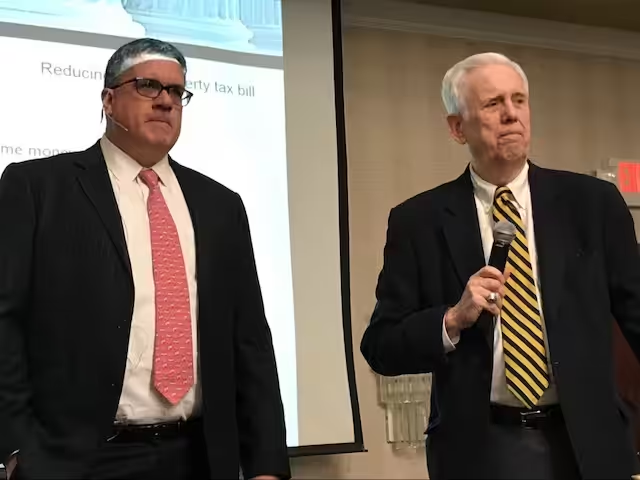
Today, Hamilton County Auditor Dusty Rhodes joined Finney Law Firm Chris Finney at a webinar hosted by the Cincinnati Area Board of Realtors to educate the public on “Ohio Property Tax Valuation Reduction.” Our thanks go to Auditor Rhodes and Christy Beaver, Director of Education the Board, for organizing and hosting this course.

Here is a link to the video. Please feel free to share it.

If our Property Tax Valuation Group can be of assistance to you, please contact Casey Jones (513.943.5673).