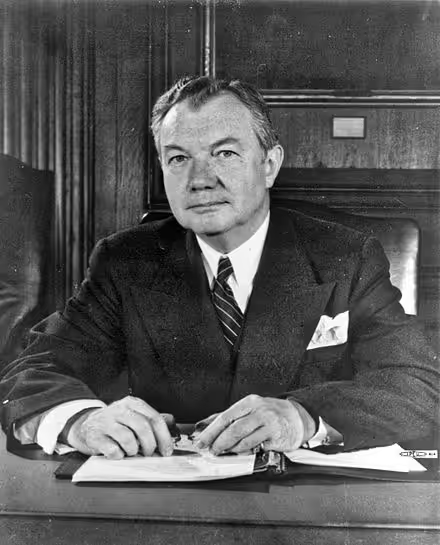
Robert H. Jackson, the only man to serve in all three roles as U.S. Attorney General, U.S. Solicitor General, and U.S. Supreme Court Justice

The Solicitor General of the United States is the attorney for the government who presents briefs and oral arguments before the U.S. Supreme Court.  The person who holds this position, thus, makes more frequent — and more important — appellate arguments than just about anyone.

Often, the U.S. Solicitor General is later appointed to the United States Supreme Court, the earlier job being both a proving ground for that important position, and a place from which the holder can become known to the President of the United States, who makes such appointments.

Thus, I got a chuckle out of this quote from former Solicitor General Robert H. Jackson, who himself was appointed to the U.S. Supreme Court by President President Theodore Roosevelt.  (As a side historical note, Jackson is the only man to have held all three jobs as U.S. Attorney General, U.S. Solicitor General and Supreme Court Justice.)

“I used to say that, as Solicitor General, I made three arguments of every case. First came the one that I planned–as I thought, logical, coherent, complete. Second was the one actually presented–interrupted, incoherent, disjointed, disappointing. The third was the utterly devastating argument that I thought of after going to bed that night.”

This is, of course, precisely what appellate advocacy is like.

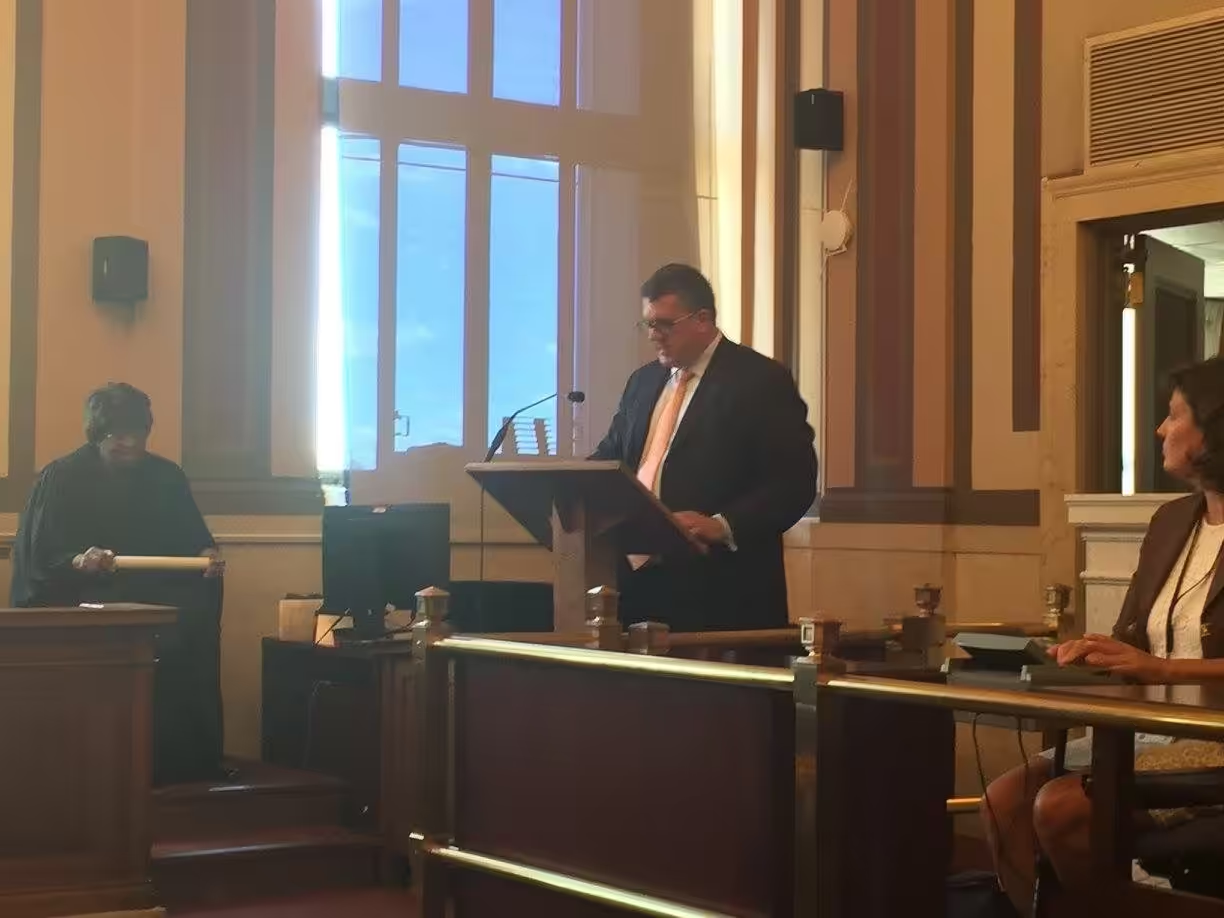
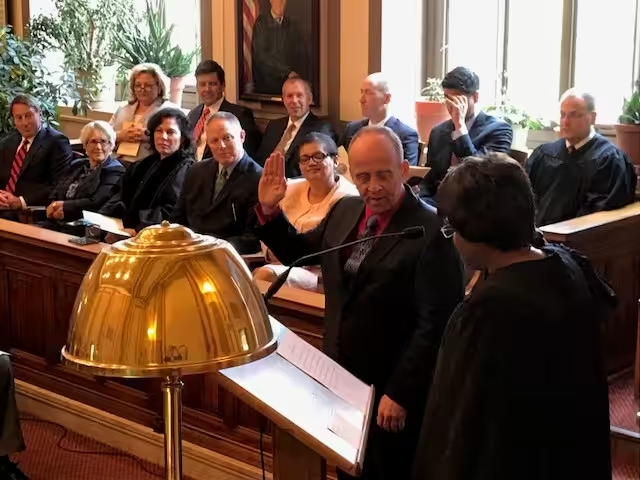
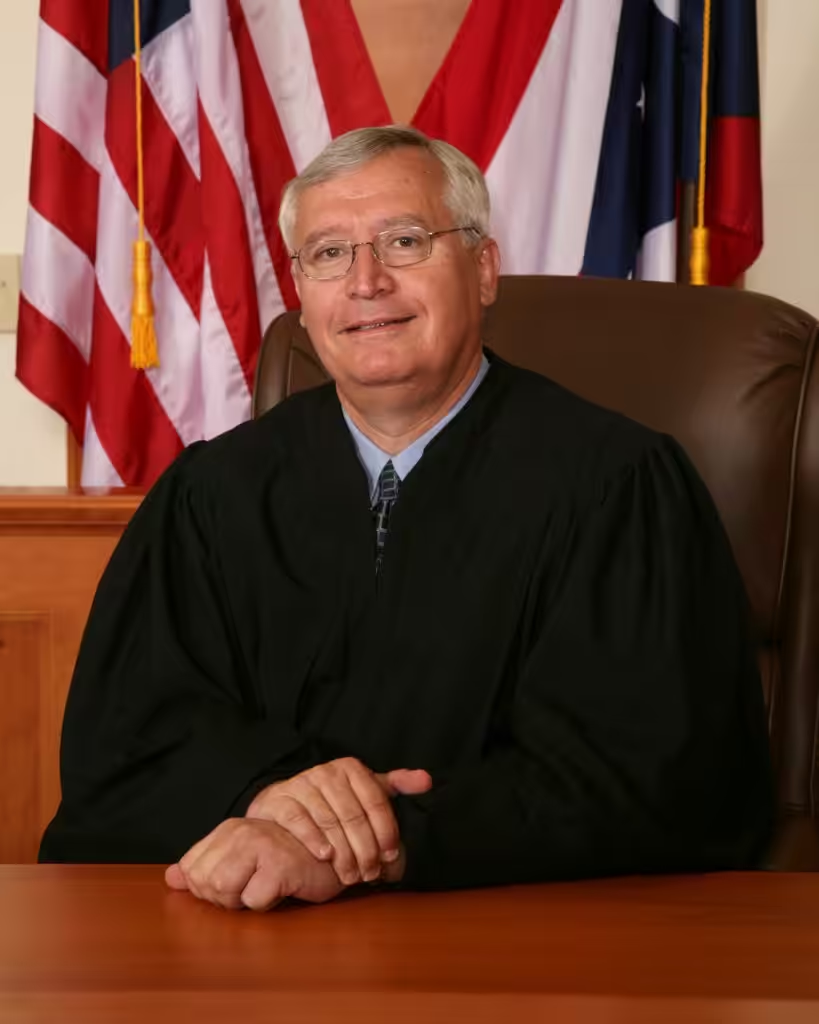
Today, former Finney Law Firm attorney (of counsel) Curt Hartman took the oath of office as a Judge on the Hamilton County Common Pleas bench.  The oath was administered by  Judge Melba Marsh.  Judge Hartman was appointed by Governor John Kasich to the bench to fill the unexpired term of Judge Beth Myers, who last fall won a seat on the Court of Appeals.

Immediately afterwards, Judge Hartman’s parents — Carl and Barbara Hartman — formally “robed” the Judge.

Our own Chris Finney served as Master of Ceremonies.

It was a joyous occasion. Congratulations, the Honorable Curt C. Hartman!

Judge Jerry McBride presided over State ex rel. Richardson v. City of Milford

Our client, former Enquirer reporter Rachel Richardson, tired of its repeated violations of Ohio’s Open Meetings Law sued the City of Milford.

The City decided to defend the case with vigor, claiming that Richardson could not prove her case that impermissible topics were addressed behind closed doors, inasmuch as what occurred in those illegal closed meetings was subject to attorney-client privilege.  In other words, because what they said was secret, we could not prove it violated Ohio law.

Once Judge McBride ruled that the City could not keep their illegal deliberations secret, the case quickly settled.

Read Rachel Richardson’s guest editorial about our “win” in today’s Enquirer.

As we have grown, the vision of the Finney Law Firm is sharpening for our clients and the public: A broad array of services offered in one firm, each practice area delivered in a quality fashion.

At our core, we are a real estate firm, with experienced transactional attorneys, a title insurance company that insures residential and commercial titles, and commercial litigators who can address virtually every aspect of disputes relating to real estate: Eviction, foreclosure, title disputes, easement disputes, construction disputes and mechanics lien claims, as well as complex real estate litigation.

Beyond that, we offer quality estate planning and probate administration and our transactional team rounds our its services with corporate formation and development, including acquisitions, dispositions and financing.

Isaac T. Heintz, Kevin J. Hopper, and Eli Krafte-Jacobs, along with paralegals Tammy Wilson and Misty L. Winkler, and Richard P. Turner at the title company, lead our transitional team day in and day out.

Our litigators are well-known for our public interest practice — handing legislative and regulatory matters aggressively, confronting government officials who would illegally interfere with their life, their business and their fortune.  Three times we have ascended to the U.S. Supreme Court, and three times we won the relief we sought with 9-0 victories there.   We apply this same sophistication and vigor to commercial litigation, personal injury, wrongful death and medical malpractice matters.

Bradley M. Gibson, Stephen E. Imm, Julie M. Gugino, and Casey A. Taylor along with paralegal Brandy E. Fitch are our quality litigation team.

Finally, we are proud to recently have expanded our litigation services to include labor and employment law with experienced litigator Stephen Imm.

When a client asks “do you do that,” I am proud to respond “yes, and we do it well.  Let me introduce you to …..”

Let us know how we we can help with your business or personal opportunity or challenge.  It is with you in mind that we have assembled this team of quality practitioners.

Effective April 6, changes to Ohio’s Good Funds Law will require that all funds coming into and out of a title company trust account be wired funds with just two exceptions: (i) funds of $1,000 or less can be by personal check or cashier’s check and (ii) funds coming in from a Realtor’s escrow account (usually the earned money) are also permitted by check.

This change is significant in that if a buyer (or seller) is not prepared to pay their monies into a closing via wire, the closing could be delayed or the buyer (or seller) in placed breach of the contract.  We have been informed that out-of-town banks with no Ohio presence may require the account holder to appear in person at their bank branch to initiate a wire, and thus a trip out of town can be necessitated if arrangements have not been made in advance.

These new rules appear to be a result of ramped-up, sophisticated and aggressive wire fraud problems associated with real estate closings, and the State of Ohio is working to assure good funds in accounts to send behind each closing.

Realtors, lenders, buyers and sellers are all advised to be aware of the new good funds requirements and to plan ahead to assure your closing is not interrupted.  For additional information regarding Good Funds, please contact Ivy Pointe Title at [email protected].


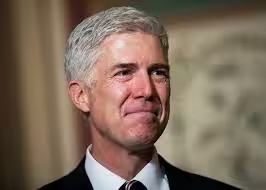
President Trump’s SCOTUS Nominee Neil Gorsuch

Our firm practices extensively in the First Amendment arena.  Thus, it was with great interest that we saw this article on the SCOTUS Blog on U.S. Supreme Court nominee Neil Gorsuch’s First Amendment jurisprudence.

A quick summary:

In many ways, Gorsuch’s opinions in this area are similar to those of the late Justice Antonin Scalia – with the possible exception that Gorsuch has been more willing to find not only that the First Amendment has been violated, but also that defendants were not entitled to qualified immunity in those cases.

It appears the First Amendment will continue to have solid backing from SCOTUS with Justice Gorsuch on the Court.

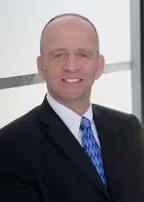
Soon-to-be-Judge Curt C. Hartman

We are pleased to pass along this press release from the office of Governor John Kasich that was just posted a few minutes ago.  It tells us that our very own Curt C. Hartman — “of counsel” to this firm since its inception — is being appointed to the Hamilton County Common Pleas Court.

Mr. Hartman is an extraordinary litigator.  He primarily has handled this firm’s appellate practice, including convincing the United States Supreme Court three times to accept cases of this firm, and winning each 9-0.  He also has handled numerous cases before the Ohio Supreme Court, Ohio’s many appellate Courts, and 6th Circuit Court of Appeals.

“We are sad to lose such a capable litigator from our ranks,” said Finney Law Firm owner Christopher P. Finney.  “But we are thrilled for the people of Hamilton County to have such a capable judge on the bench.  It is to the considerable credit of Governor Kasich that he recognized the talent of Curt Hartman and elevated him to this important position.  Congratulations to our own Curt C. Hartman!”

Mr. Hartman will be sworn in before month’s end.  Stay tuned for details of the ceremony.

First, we hear pretty regularly from Realtors, investors, and lenders of incredibly ingenious and devious wire fraud attempts.  And indeed some of these endeavors  succeed.  These are happening with greater and greater regularity in every community in the nation by fraudsters throughout the globe.

Second, we got this alert from our underwriter, First American Title Insurance Company today:

Fridays before holiday weekends represent an exponentially higher risk to fall victim to WIRE FRAUD.

Criminals know our business and have learned to take advantage of a busy agent’s desire to provide customer service and quickly move transactions to conclusion before the banks close for a long weekend.

NEVER ACCEPT WIRE INSTRUCTIONS VIA EMAIL without utilizing call-back verification procedures to a known, safe phone number. Don’t fall victim to wire fraud.

Enjoy a safe and secure holiday weekend.

So, to our clients and friends, we caution you to be safe out there!


Relating to Christopher P. Finney’s presentation on February 16th, 2017 before Cincinnati’s Lawyers’ Club entitled “Mr. Finney goes to the United States Supreme Court,” we wanted to present several links for those wanting to do further study  on the topic.

First, as background, SCOTUSblog.com exists for the purpose, in part, of compiling and presenting key links for United States Supreme Court cases, from briefs, to oral argument transcripts and audio recordings, as well as in dept commentary.  So, most of our links are just back to their site, for which we are greatly appreciative.

Some are links to original documents on the Finney Law Firm scribd.com site.

And for some extra reading, a few Amicus Briefs from the SCOTUS case:

Next Thursday, Christopher P. Finney will present to Cincinnati’s Lawyer’s Club the topic “Mr. Finney goes to the United States Supreme Court,” a speech on his experiences in having a case accepted by the nation’s highest court, having it presented (another attorney made the oral argument) and winning in a unanimous ruling.

“It has been the highlight of my legal career to date has been to position a case for acceptance by the United States Supreme Court, to have it presented and to win,” said Finney.  “The experience was made all the sweeter because up until the nine Justices spoke, not a single judge, at the trial court level or at the appellate level, saw any merit in our arguments.  Strategy, persistence and a firm belief in our position prevailed.”

Within just months of forming the Finney Law Firm in 2013, we learned that one of our cases had been accepted for oral argument at the United States Supreme Court — Susan B. Anthony List v. Ohio Elections Commission.  Getting a case accepted for oral argument by the United States Supreme Court is the legal equivalent of lightning striking.  The Supreme Court typically accepts fewer than 1% of all cases for which certiorari petitions are presented, and many of those arise from either very high profile issues of great public interest or cases of statutory interpretation arising from the D.C. Circuit.  In the year in which we presented, more than 10,000 petitions for writs of certiorari were presented, and only 69 were accepted for oral argument.

The Susan B. Anthony List case challenged Ohio’s political “false claims” statute, in which the Ohio Elections Commission sits (used to sit) in judgment of whether statements made during the course of political campaigns — candidate and issue — were “false” and if so, could refer them for criminal prosecution, involving up to six months in jail.

Our legal team presented that case in April of that year, and won a unanimous ruling from the U.S. Supreme Court in June, authored by Justice Clarence Thomas.  The case as it ascended to the United States Supreme Court was merely about whether our clients had standing to challenge the subject statute.  The Supreme Court decision found that standing existed and remanded the case for further proceedings in the trial and appellate courts, where some months later our clients ultimately prevailed.

Navigating legal shoals to have a case accepted by the United States Supreme Court and positioning it most strongly for victory, including by its written and oral presentation, involve intense strategy and hard work, much like a chess game or a championship boxing match.

That experience in this one case, and two more that the firm had accepted and won on only written briefs, will be presented by Christopher P. Finney next Thursday, February 16, 2017 before Cincinnati’s Lawyers’ Club at the Montgomery Inn Boathouse at 11:30 AM.

Also presenting that same day from 12:45 to 1:45 is Cincinnati attorney Daniel Drew on Civil Asset Forfeiture Reforms.

If you want to attend, you may sign up by contacting attorney Bob Cettel at (513) 325-2279 or via email at [email protected].  The cost is $20 per CLE session for Cincinnati Lawyer Club members and $25 per session for non-members.  The cost is $30 per year to join the Cincinnati Lawyers Club.

The Cincinnati Lawyers’ Club was founded in 1920 and gathers attorneys together for civic undertakings and continuing legal education programs.  We thank them for this opportunity to present our experiences on this exciting journey to the United States Supreme Court.

Please feel free to join us that day!